Yes, you can refuse a portable breath screening test in New Jersey without facing the same penalties that apply to refusing a chemical test at the police station. The portable breath test (PBT) is not covered by the state’s refusal statute under N.J.S.A. 39:4-50.4a. However, refusing this roadside test does not prevent arrest, as officers may rely on other observations to establish probable cause for a DUI charge.
At The Kugel Law Firm, New Jersey DUI lawyer Rachel Kugel helps drivers throughout Hudson County understand their rights during traffic stops and breath test requests. Whether you were offered a portable breath test at the roadside or arrested and asked to take an official chemical test at the station, our drunk driving attorneys can analyze your case and identify potential defenses.
This guide explains what a portable breath test is, how it differs from the chemical test given after arrest, when you can legally refuse, and what penalties you may face for refusing either test. You will also learn about your rights under New Jersey’s implied consent law. Call The Kugel Law Firm at (973) 854-0098 to speak with Rachel Kugel about your case.
What Is a Portable Breath Test?
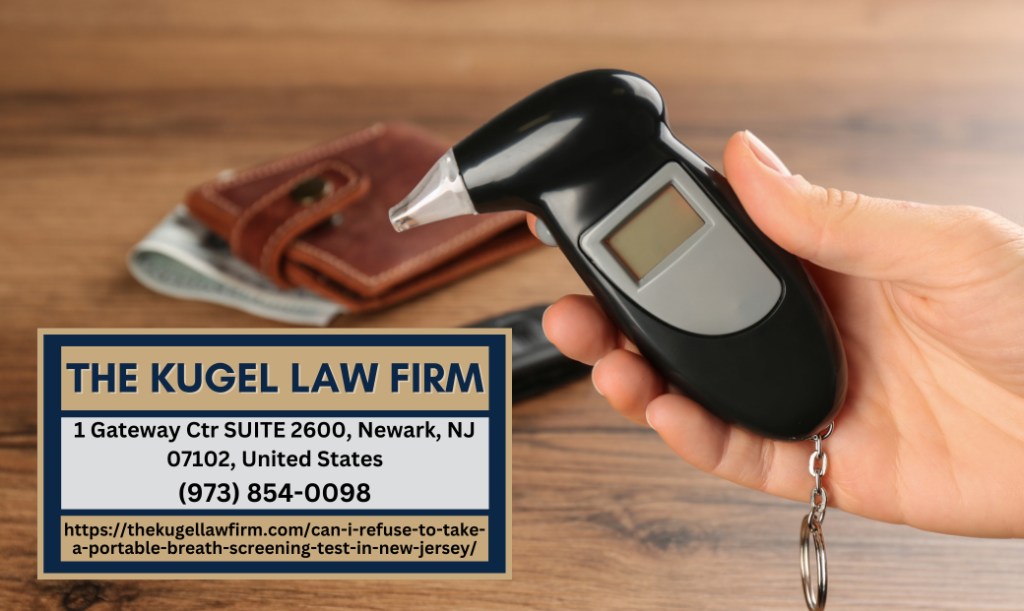
A portable breath test is a handheld device used by law enforcement during a traffic stop to measure your blood alcohol concentration (BAC). Officers typically administer the PBT at the roadside after conducting field sobriety tests. You blow into the device, which provides a rapid estimate of the alcohol level in your system.
Although the PBT produces quick results, it is a screening tool used during the stop. In New Jersey, the evidential breath test is administered after arrest on an approved Alcotest instrument (currently the Alcotest 9510). Officers may use the PBT result along with other observations to help decide whether there is probable cause to arrest and request the post-arrest breath test.
This distinction is important. The roadside screening is a preliminary tool for the officer’s investigative purposes. The chemical test administered after your arrest, typically using the Alcotest 9510 device at the police station, is what produces admissible evidence in court.
Can I Refuse to Take a Portable Breath Screening Test in New Jersey?
Yes, New Jersey law allows you to refuse a portable breath screening test without direct legal consequences for that refusal. The state’s refusal statute applies only to chemical tests administered after arrest, not to preliminary roadside screening devices.
This means officers cannot charge you with refusal under N.J.S.A. 39:4-50.4a simply for declining the PBT. However, refusing the roadside test does not guarantee you will avoid arrest. Officers can still arrest you based on other signs of intoxication they observe during the traffic stop. These observations may include slurred speech, bloodshot eyes, the odor of alcohol, or poor performance on field sobriety tests.
Once you are arrested and taken to the police station, the situation changes. New Jersey operates under an implied consent law. By driving on public roads in the state, you have automatically agreed to submit to chemical testing when an officer has probable cause to believe you are driving under the influence. Refusing to take the official breath test at the station triggers separate refusal charges and carries mandatory penalties.
The portable breath test is optional, and refusal does not trigger a 39:4-50.4a refusal charge. The chemical test at the station is not voluntary under New Jersey’s implied consent law. Understanding this difference can help you make informed decisions during a traffic stop.
Key Takeaway: You can refuse a portable breath test without refusal charges, but officers may arrest you based on other observations. Once arrested, refusing the chemical test at the station results in separate refusal charges with mandatory penalties.
Rachel Kugel can review the circumstances of your traffic stop and determine whether the officer had legal grounds to arrest you. Call The Kugel Law Firm at (973) 854-0098 to discuss your case.
How Does a Portable Breath Test Differ from a Station Chemical Test?
Understanding the difference between these two types of tests is essential for anyone facing DUI charges in New Jersey.
Location and Timing
The portable breath test happens at the roadside immediately after the traffic stop. The officer uses a handheld device to obtain a preliminary BAC reading. This test occurs before arrest in most cases.
The chemical breath test takes place at the police station after you have been arrested. New Jersey uses the Alcotest 9510 as the evidential breath-testing instrument. Breath-test results are generally admissible when the instrument is an approved device, and the required procedures and foundational proofs are satisfied.
Legal Status and Admissibility
A portable breath test is primarily a roadside screening tool used in the officer’s investigation. In New Jersey, the post-arrest Alcotest is the evidential breath test governed by the State’s breath-testing framework, and that is the BAC evidence prosecutors typically rely on at trial.
Chemical test results from the Alcotest device are admissible in court when proper procedures were followed. Prosecutors use these results as key evidence to prove you were driving with a BAC above the legal limit.
Consequences of Refusal
Refusing a portable breath test carries no direct legal penalties. You cannot be charged with refusal for declining this roadside screening. However, refusal may strengthen the officer’s suspicion and could lead to your arrest based on other factors.
Refusing the post-arrest breath test triggers a separate motor-vehicle offense under N.J.S.A. 39:4-50.4a, with mandatory consequences that include loss of driving privileges tied to ignition interlock installation, fines, and IDRC requirements.
DUI Defense Attorney in New Jersey – The Kugel Law Firm

What Is New Jersey’s Implied Consent Law?
New Jersey’s implied consent law requires all drivers operating motor vehicles on public roads to submit to chemical testing when law enforcement has probable cause to believe they are driving under the influence. This law is codified in N.J.S.A. 39:4-50.2.
By obtaining a driver’s license and driving on New Jersey roads, you have automatically given your consent to provide breath samples for chemical testing. This consent is implied by your decision to drive; it is not optional and does not require verbal agreement at the time of testing.
The implied consent law applies specifically to breath tests conducted at the police station after arrest. It does not apply to portable breath tests given at the roadside during a traffic stop. New Jersey’s implied-consent statute here concerns breath testing; blood testing typically requires either a warrant or a recognized exception under Fourth Amendment case law (for example, warrantless blood tests are treated differently than breath tests).
What Happens If You Refuse?
When you refuse to submit to a breath test at the station, you violate New Jersey’s implied consent law. This violation is a separate offense from DUI and carries its own set of penalties. Law enforcement must read you a Standard Statement for Motor Vehicle Operators before administering the test. This statement explains your legal obligation to comply and the consequences of refusal.
Refusal can include explicit refusal, ambiguous or conditional responses, silence, or providing inadequate breath samples. New Jersey courts have held that you must give “unconditional, unequivocal assent” to the breathalyzer demand. Any hesitation, negotiation, or attempt to delay the test can be treated as a refusal.
Is Refusal a Separate Charge from DUI in New Jersey?
Yes, refusing to take a breath test is a distinct offense from DUI in New Jersey. You can be charged with both violations simultaneously, and each carries separate penalties.
A DUI charge requires the prosecution to prove you were operating a vehicle while impaired by alcohol or drugs. Evidence may include your BAC level, field sobriety test performance, and the officer’s observations of your behavior and physical condition.
A refusal charge requires the prosecution to prove four elements. First, the traffic stop must have been lawful. Second, the officer must have had probable cause to believe you were driving under the influence. Third, the officer must have properly read you the Standard Statement for Motor Vehicle Operators. Fourth, you must have either refused to provide breath samples or failed to provide valid samples.
The refusal violation occurs simply by declining the test or failing to provide adequate samples. It does not depend on whether you were actually intoxicated at the time of the stop. This means you can be acquitted of DUI but still convicted of refusal. You can also be convicted of both offenses and face penalties for each.
When you are charged with both DUI and refusal, the penalties are imposed separately. Under N.J.S.A. 39:4-50.4a, for a first refusal offense, the revocation may be concurrent with or consecutive to any revocation imposed for a DUI conviction arising out of the same incident; for a second or subsequent refusal offense, the revocation shall be consecutive to any DUI revocation.
What Are the Penalties for Refusing a Breath Test in New Jersey?
New Jersey imposes mandatory penalties for breath test refusal that escalate with each subsequent offense.
| Offense | Fine | License Suspension | Ignition Interlock (IID) | Additional Requirements |
|---|---|---|---|---|
| First Offense | $300–$500 | License forfeiture until IID installation | 9–15 months after license restoration | IDRC attendance, $1,000/year surcharge for 3 years |
| Second Offense | $500–$1,000 | 1–2 years | During suspension + 2–4 years after restoration | IDRC attendance, $1,000/year surcharge for 3 years |
| Third or Subsequent | $1,000 | 8 years | During suspension + 2–4 years after restoration | IDRC attendance, $1,500/year surcharge for 3 years |
In addition to court penalties, refusal convictions also trigger insurance surcharges for multiple years, commonly listed as $1,000 per year for three years for first/second refusal, and $1,500 per year for three years for third or subsequent refusal.
How Do Portable Breath Tests Differ from Field Sobriety Tests?
New Jersey law enforcement uses both portable breath tests and Standardized Field Sobriety Tests (SFSTs) during DUI investigations. While both help officers assess whether a driver is intoxicated, they measure different things and serve different purposes.
Portable Breath Tests
The portable breath test measures blood alcohol concentration by analyzing your breath. Officers use this device to obtain a numerical BAC reading at the roadside. As discussed earlier, these results are not admissible in court as evidence of intoxication. Law enforcement uses the PBT reading primarily to help determine whether probable cause exists to make an arrest.
Standardized Field Sobriety Tests
The National Highway Traffic Safety Administration (NHTSA) endorses three standardized field sobriety tests. These tests are designed to measure physical and cognitive impairment that correlates with a BAC over 0.08%. The three tests are the horizontal gaze nystagmus, the one-leg stand, and the walk-and-turn.
Officers receive training on how to administer these tests according to standardized instructions. Each test has specific indicators that trained officers look for when evaluating performance. The tests do not have a strict pass or fail outcome. Instead, they use decision points to help officers determine whether performance is satisfactory.
Field sobriety tests are not the same as the post-arrest breath test demanded under implied consent. In New Jersey, refusal to perform field sobriety tests can be used to support an inference of intoxication at trial.
Key Differences
The PBT provides a numerical measurement of BAC, while field sobriety tests assess physical coordination and cognitive function. Both are voluntary, and neither can be used to charge you with refusal under New Jersey law. Results from field sobriety tests can be introduced as evidence in court, while PBT results cannot.
Talk to a New Jersey DUI Attorney Today
Facing DUI or breath test refusal charges can feel overwhelming. You may be worried about losing your license, paying heavy fines, or having a criminal conviction on your record. These charges can affect your ability to drive to work, maintain professional licenses, and carry out daily responsibilities.
Rachel Kugel has defended clients charged with driving under the influence throughout New Jersey. At The Kugel Law Firm, our New Jersey DUI attorneys analyze every aspect of your case, from the legality of the initial traffic stop to the accuracy of the breath test procedures. We handle cases at the Jersey City Municipal Court, Hudson County Superior Court, and municipal courts throughout New Jersey. We can challenge probable cause, question whether officers followed proper procedures when administering tests, and identify violations of your constitutional rights.
Call The Kugel Law Firm at (973) 854-0098 to schedule a consultation. Our office in Newark serves clients throughout Hudson County, Jersey City, and all of New Jersey. We can create a clear game plan for your DUI: what to expect in court, what evidence matters, and how we can position your case for dismissal, downgrade, or minimized sentencing where possible.